The WragsInk Philly Fiction Anthology Launch and Reading at Coffee Beanery in Media, Pa., March 3, 2012.
I read “Heart Wood,” excerpted from my unpublished novel, “The Sugarmaker’s Son,” at the WragsInk Philly Fiction Anthology Reading and Book Launch March 3, 2012, at the Coffee Beanery in Media, Pa.
Thank you to the folks at WragsInk, Editor Dennis Finocchiaro, and everyone who came out to support the authors.
I have an interview with Chris Hardwick (The Nerdist podcast and television show) today. Check out my review of his book The Nerdist Way on Culturemob.
Though his podcast features interviews with comedians for the most part there are so many amazing moments sprinkled throughout the shows. Chris and his fellow comedy nerds Matt Mira and Jonah Ray are something that is increasingly rare: funny and earnest.
It’s easier to be detached or winking at the audience. He risks simply saying something honest and caring. The Nerdist — It’s a great thing to jam in your ear holes in the morning.
My short story “Heartwood” will be published in the Philly Fiction anthology in a few weeks. It’s excerpted from my unpublished novel The Sugarmaker’s Son, which is currently on the market.That also means I will be out and about reading in the local area, and you should be out and about meeting up with me.
If you live in or around Philly, please check back here for information about upcoming reading dates. I promise to take a few minutes to chat with anyone who mentions that they follow the blog. Also, I’ll sign any publication (new or old) that features one of my stories.
Writers stay tuned: I’m posting about creating scenes, using painters as inspiration. It’s a newer technique I stumbled upon while finishing my first novel and beginning my second.
Sorry, been away for too long. Let me explain. No, there’s too much. Let me sum up.
My first novel The Sugarmaker’s Son, in progress for five years, is currently on the market with agents. So far the query letter and partials have been getting reasonably positive responses. Unfortunately, I can’t say anything more at this point. Suffice to say, if a contract is signed or check cut, I’ll announce it here first.
Want a preview of the novel? “Heartwood,” a short story excerpted from the novel will appear in WragInk’s Philly Anthology along with several emerging area writers. Be sure to pick up a copy in January.
While I’m waiting on word about the first I’ve begun working on my second novel. This will be very different than my first book, but not so much a reader wouldn’t make the leap. Anyway, no sequel here. I can say even less about this novel than the first, alas.
Writing Process Progress
I can say that I expect the first draft will take much less time though. When I first tried to write The Sugarmaker’s Son, I was enrolled in a novel workshop at Rosemont College. Never wrote a novel before the class and the best plan I had was to write a novel based on a short story. My synopsis and outline were abandoned fairly early; I finished it through sheer will. Most of the characters I hadn’t defined yet; several of the plot points were vague, not at all connected. I was terrified that I would run out of material and desperately worked to keep the story afloat.
The second draft, on the other hand, was much worse. A lot of tweaks; more questions of plot and characters answered, but the plot went wildly off track. The outline was almost like a different book. I kept a list of plot threads and keep writing to resolve them as the story moved ahead, on intuition. Not a recommended approach. So frustrating to reach a point when you have a lot of writing (like a slab of clay) and not know what to do with it.
For the third draft, I had begun to lose track of what had been written, what was good or bad, what I wanted to keep or ditch. So I took the story down to the framework and created a five-page synopsis (I call it a treatment) of the book, accounting for the pieces from the two drafts I thought worked. More than a third of the story I’d still have to write from scratch. After that was solid, resolving almost all of the questions I had avoided through two drafts, I created an outline of each chapter. By making a very thorough synopsis I had settled the overall story in my mind before starting again, ensuring I didn’t go too far off the path. And when I did, it was because my mind was filling in a new, useful idea.
So far, I’ve finished a synopsis of the second novel and keep refining it. There are a few points I still need to work out, but I’ve avoided beginning the first chapter until I’m happy with the synopsis and the outline. And that has been a struggle: it feels so ready in my mind.
This process, though, will save time and effort. Instead of the fear of writing a novel I felt in the first draft or the frustration of the second, I can see the story and know there area lot of fun chapters ahead. And, as an author, that’s a darn good feeling.
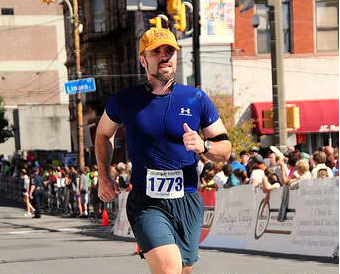
I’d waited two years to run the Steamtown Marathon, a wonderful mid-sized race held in Scranton, Pa. Trained since the winter, peaking at 45 miles a week twice. The morning of the race, people around me murmured and stretched, but all things considered, I felt oddly calm.
I spent the time tweaking the songs on my iPod’s running playlist and deciding at what point in the race I would start listening to my audio version of A Scanner Darkly.* Running alone,I planned to tune out my surroundings and any pain.
But then an unusual thing happened, something I hadn’t planned on. Two miles into the race, I noticed a man running next to me, our strides perfectly matching. “Seems like we’re running the same pace,” he said neutrally.
“I think you’re right,” I replied, still looking ahead.
“I’m Dave.”
“Shawn.”
“How fast are we running anyway?”
“Clocked the first two miles at about 8:30 pace,” I said. “I’m trying to not go out fast, just be very conservative.”
“Oh. I trained 11-minute miles on a treadmill.”
This struck me as curious. Why would he run so much faster than his training pace? How could he? Turns out that he’d prepared in an almost zen way, logging slow, easy miles on the treadmill in his basement, finishing with a four-hour, 21-mile long run a week ago. Instead, I’d followed a plan in a Runner’s World magazine, studied the course layout, and strategized fueling and hydration.
We had a lot in common: both laid off during the recession, two young kids at home, and happily employed at new jobs. Dave worked as a fork lift operator, four ten-hour days a week.
And so it went, twenty miles vanishing as we talked. Eventually we decided to cross the finish line together, to greet our families and introduce them to one another. At the halfway point, we were on pace for a 3:50 marathon. I was optimistic that we both had a solid second half left. That was half right, it turned out.
“Mile 18. Want to pick it up?” he asked.
My hip muscles, fatigued from ten miles of downhill running, had only grown weaker with the uneven surface of a rails-to-trails path. “I’m not sure I have that in me, Dave.”
“Ok, buddy. I’m going to stay with you. Just tell me what you need. We can go faster, we can slow down.”
At mile 22, I was counting down the distance left and feeling weaker every step. I kept telling myself not to slow down, but dehydration and heat exhaustion had set in—I shivered in the shade and felt burning hot in the sun.
Finally, at mile 23, I told Dave to go ahead so I could walk and drink more fluids.
“You’re my wing man. I’m staying with you,” he said.
“You have a better race ahead,” I said. “Please go.”
He protested, but finally agreed. “You don’t want to tell your family that you didn’t finish,” he reminded me before moving ahead.
Between mile 23 and 25, I drank Gatorade and water, and divided my time between running and walking. You only have a couple miles. You can make it, I thought. Come on! Run! Slowly, but surely I found myself jogging again.
The final 1.2 miles I ran until I reached a three-block hill in Scranton that looked like a climb on a roller coaster. I can’t remember how I made it up that monster, but I heard someone nearby yell, “That’s the finish just over the hill, Mr. Muscles! Keep going!”
The final fifth of mile came after the crest of the hill. I saw an older man crumpled next to a car with medical staff nearby. I eyed the finish line and put everything I had left into moving forward by any means necessary.
The crowds were cheering and I looked everywhere as I ran. I caught sight of my wife and kids, then my sister and her family. I pointed at them and burst over the finish line.
After receiving a finisher’s medal, I folded in to a chair and sat there for a long time under a shiny space blanket. Then I saw my family and everyone was all smiles. That’s when it dawned on me that I’d made it.
Still, I couldn’t figure out where Dave had finished. I hope he ran equal halves and crossed better than four hours, but I can’t be sure. I only hope that he was as happy to see his biggest fans as I was.
Here’s a video of my finish:
Official Race Time: 4:08:17
* This might be the first race recap in history that mentions Phillip K. Dick.
“If you blow away a dandelion, first close your eyes and make a wish,” Penny said one afternoon in August. She pulled one from the grass, held it like a wand, and blew, the puff of seeds scattering hazy white.
Nols rubbed his forehead, fingertips collecting oil. The corners of his eyes burned. They did not talk about his bloodshot eyes or the odor of stale beer lingering on his clothes. It was six hours after he had come home drunk and his parents threatened to throw him out again. He’d left, walked four miles to her place, and sacked out on the floor, but hardly slept.
Two hours before work, they lay tangled together in a field, Penny’s head on his chest, her arm across his stomach. The flower scent of her sweet shampoo lingered, honeysuckle or lavender, he guessed. Her cool fingers moved across his skin like waves. Nols had never met a girl like her. He liked to watch her in those quiet moments. He liked to listen to her voice, the rhythm of accent flicking on her teeth.
“I wished to one day become an artist. Watercolors, maybe,” Penny said. “Allen?”
No one had called him that in weeks. “Huh?”
“Try it.”
He didn’t want to. At nineteen, plucking dandelions had gone the way of rubbing buttercups on your chin. Kids’ stuff. But he’d fallen for her, fallen hard. Fallen faster because he knew that soon, Penny, his first real love, was doomed to leave. He existed inside a wave all summer, her forces and tides pulling him along, sweeping him far away from shore.
“Ok,” he said. Nols picked up the dandelion, looked at Penny, and before he blew, he closed his eyes, trying to not ask for the impossible: that she might stay past summer.
*
After Nols and Moises had drained half the rum while cruising, they scanned around the radio for quieter music. Super star in your own private movie, Mazzy Star sang absently over lazy electric feedback. I wanted just a minor part. They were at a red light, the engine of the Camaro rattling like an old man’s cane, always near breakdown. The night was so hot they kept the windows rolled up and blasted air conditioning until their fingertips ached with chill.
A black and white patrol car pulled alongside. The cop stared through Nols.
“We’re busted for sure,” Nols said, the last word slurring. Part of him didn’t care—he’d been at the station
an hour ago. They’d called him in because Assateague Island Seashore Officials found a body in the surf and needed positive identification. Penny had been missing for six days.
“Take a breath,” Moises said. “Take a breath.”
“He’s looking right at me. He knows.”
“He’s testing us, to see if you’ll freak.” Moises slid the rum behind the seat, slow and easy. “Nols, just be cool. Don’t look.”
Ten seconds passed as the standoff continued— Nols looked ahead, willing the traffic light to change; Moises tapped his thumb on the steering wheel in time with the music. The light dropped to green.
Finally, the cop turned up an alley near Michael’s Deli, heading towards the beach.
“That was too close,” Nols said and sighed, leaning his head against the window, remembering the evening they called the police about Penny. When he couldn’t find her that morning, Nols called everyone they knew. And when she missed work in the afternoon, he dialed 9-1-1.





 Shawn Proctor