Shawn Proctor is a fiction writer living in the greater Philadelphia area. He graduated from the MFA Program at Rosemont College and the Professional Writing Program at Kutztown University.
His fiction has appeared or is forthcoming in the Our Haunted World Anthology, Schuylkill Valley Journal, Storyglossia, Mississippi Crow, The Circle, The StoryTeller, and BlazeInk, and was a finalist in The Delaware Beach Life Writing Contest.
He is currently working on his first novel.
His journalism has appeared in The Philadelphia Inquirer, Main Line Today, Ale Street News, and Victory Brewing Company's Web site, and he published a roleplaying module with Chaosium, Inc.
“Nobody tells this to people who are beginners, I wish someone told me. All of us who do creative work, we get into it because we have good taste. But there is this gap. For the first couple years you make stuff, it’s just not that good. It’s trying to be good, it has potential, but it’s not. But your taste, the thing that got you into the game, is still killer. And your taste is why your work disappoints you. A lot of people never get past this phase, they quit. Most people I know who do interesting, creative work went through years of this. We know our work doesn’t have this special thing that we want it to have. We all go through this. And if you are just starting out or you are still in this phase, you gotta know its normal and the most important thing you can do is do a lot of work.”
“Put yourself on a deadline so that every week you will finish one story. It is only by going through a volume of work that you will close that gap, and your work will be as good as your ambitions. And I took longer to figure out how to do this than anyone I’ve ever met. It’s gonna take awhile. It’s normal to take awhile. You’ve just gotta fight your way through.”
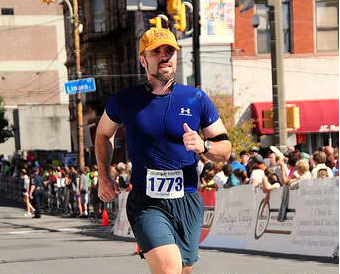
I’d waited two years to run the Steamtown Marathon, a wonderful mid-sized race held in Scranton, Pa. Trained since the winter, peaking at 45 miles a week twice. The morning of the race, people around me murmured and stretched, but all things considered, I felt oddly calm.
I spent the time tweaking the songs on my iPod’s running playlist and deciding at what point in the race I would start listening to my audio version of A Scanner Darkly.* Running alone,I planned to tune out my surroundings and any pain.
But then an unusual thing happened, something I hadn’t planned on. Two miles into the race, I noticed a man running next to me, our strides perfectly matching. “Seems like we’re running the same pace,” he said neutrally.
“I think you’re right,” I replied, still looking ahead.
“I’m Dave.”
“Shawn.”
“How fast are we running anyway?”
“Clocked the first two miles at about 8:30 pace,” I said. “I’m trying to not go out fast, just be very conservative.”
“Oh. I trained 11-minute miles on a treadmill.”
This struck me as curious. Why would he run so much faster than his training pace? How could he? Turns out that he’d prepared in an almost zen way, logging slow, easy miles on the treadmill in his basement, finishing with a four-hour, 21-mile long run a week ago. Instead, I’d followed a plan in a Runner’s World magazine, studied the course layout, and strategized fueling and hydration.
We had a lot in common: both laid off during the recession, two young kids at home, and happily employed at new jobs. Dave worked as a fork lift operator, four ten-hour days a week.
And so it went, twenty miles vanishing as we talked. Eventually we decided to cross the finish line together, to greet our families and introduce them to one another. At the halfway point, we were on pace for a 3:50 marathon. I was optimistic that we both had a solid second half left. That was half right, it turned out.
“Mile 18. Want to pick it up?” he asked.
My hip muscles, fatigued from ten miles of downhill running, had only grown weaker with the uneven surface of a rails-to-trails path. “I’m not sure I have that in me, Dave.”
“Ok, buddy. I’m going to stay with you. Just tell me what you need. We can go faster, we can slow down.”
At mile 22, I was counting down the distance left and feeling weaker every step. I kept telling myself not to slow down, but dehydration and heat exhaustion had set in—I shivered in the shade and felt burning hot in the sun.
Finally, at mile 23, I told Dave to go ahead so I could walk and drink more fluids.
“You’re my wing man. I’m staying with you,” he said.
“You have a better race ahead,” I said. “Please go.”
He protested, but finally agreed. “You don’t want to tell your family that you didn’t finish,” he reminded me before moving ahead.
Between mile 23 and 25, I drank Gatorade and water, and divided my time between running and walking. You only have a couple miles. You can make it, I thought. Come on! Run! Slowly, but surely I found myself jogging again.
The final 1.2 miles I ran until I reached a three-block hill in Scranton that looked like a climb on a roller coaster. I can’t remember how I made it up that monster, but I heard someone nearby yell, “That’s the finish just over the hill, Mr. Muscles! Keep going!”
The final fifth of mile came after the crest of the hill. I saw an older man crumpled next to a car with medical staff nearby. I eyed the finish line and put everything I had left into moving forward by any means necessary.
The crowds were cheering and I looked everywhere as I ran. I caught sight of my wife and kids, then my sister and her family. I pointed at them and burst over the finish line.
After receiving a finisher’s medal, I folded in to a chair and sat there for a long time under a shiny space blanket. Then I saw my family and everyone was all smiles. That’s when it dawned on me that I’d made it.
Still, I couldn’t figure out where Dave had finished. I hope he ran equal halves and crossed better than four hours, but I can’t be sure. I only hope that he was as happy to see his biggest fans as I was.
Here’s a video of my finish:
Official Race Time: 4:08:17
* This might be the first race recap in history that mentions Phillip K. Dick.
Benjamin Percy, author of Refresh, Refresh and The Wilding
Peter Straub called him one of our most accomplished younger writers. His short fiction, said Ann Patchett, marks the beginning of a long and brilliant writing career.
Benjamin Percy, author of two novels, Red Moon (forthcoming from Grand Central / Hachette in 2012), The Wilding (Graywolf, 2010), and two books of short stories, Refresh, Refresh (Graywolf, 2007) and The Language of Elk (Carnegie Mellon, 2006), first caught my attention when his short story “Refresh, Refresh” appeared in Best American Short Stories and The Pushcart Anthology then was read on NPR’s Selected Shorts.
His stories will grip you from the start. They pulse with violence and danger. They also surprise with tenderness and humor. The ideal Percy reading experience is in the dark, just a single light on the page, the sounds of the wilderness filtering through a nearby window. It’s meant to be terrifying. It’s meant to chase away sleep.
Shawn Proctor: You mention in an article on writing that creating short fiction is very different than creating novels. How did crafting The Wilding differ from the process that resulted in your short stories, like “Refresh, Refresh”?
Benjamin Percy: I could go on for a long time about the differences between writing novels and short stories. I’m speaking generally, of course, but their construction varies re: compression (the time span of a short story is typically a glimpse into a life in crisis and often what is left out is as important as what is included), the intensity of language (the typically rich, dense, challenging sentences of a short story would exhaust a reader after 200 pages), with structure (short stories tend to be more impressionistic, novels more causal), with plotting (with few exceptions, novels must have a plotted engine), and blah blah blah. I essentially teach a course on this same subject, so to cram a semester’s worth of information into a paragraph is impossible. Suffice it to say the difference is more than length — and it took me four failed manuscripts to comprehend the complex machinery of novel-writing.
SP: The Wilding contains parts of two short stories which appeared in your previous collection Refresh, Refresh. Why did you choose to incorporate these, especially “The Woods,” into your novel?
BP: My father, after finishing my first short story collection, said, “You know what’s wrong with your stories? They’re too short.” I found this amusing at the time, but years later, it made a kind of sense to me, when I kept thinking about the characters in “The Woods,” wondering what they were up to. So I gave them a little more acreage to roam around on and a 15-page story became a 150-page shnovel. I had a lot of editing and world-building yet to do — to make the manuscript into a full realized, multi-faceted novel — but that’s where it began. And I think this is true for many writers. You explore something in the short form, and then wonder, could I keep going? Am I excited enough about these characters and is there enough dramatic possibility here to endure a novel’s sweep?
SP: Several of your short stories and The Wilding use bears as an element. Is there an experience that instilled a fascination of bears in you?
BP: I’ve had too many to list. It began in high school. One of my high school teachers had been attacked by a grizzly. She tried to climb a tree and the bear caught her by the leg and chewed off all the meat on her calf. Whenever she would turn around to scribble on the chalkboard, I would simply stare at her gummy bone of a leg with wonder. Later, when working at Glacier National Park, I would run into grizzlies every day — blasting across the trail in front of me, huffing outside my tent in the back country, shambling across a nighttime parking lot. One of my colleagues there was eaten — and then my roommate was stalked for ten miles by the same mother and cubs. So I have a lot of terror in the well to draw a bucket from…
SP: Many of your stories settle between genres, like literary fiction, science fiction, and horror. The Wilding, for example, has great character moments, but the menace in the woods with Seth and the bear becomes as tense as any horror or survival thriller. Is it a conscious choice to avoid easy categorization or a natural offshoot of the stories you tend to write?
BP: I want to write pretty sentences. I want to build three-dimensional characters. I want to polish my metaphors until they glow. I want to mine the subterranean themes beneath the surface of the narrative. But I also want the reader to wonder, sometimes desperately, what happens next?
SP: And one fun question that I always have a curiosity about with other writers — can you describe the place where you write? And do you normally write in that place or does it change often?
BP: Ideally, I’m writing in the same place at the same time every day. When I’m in a normalized routine, I tend to be most productive and generate the most striking material. But hey, I’ve got two kids, I travel constantly, so that’s impossible. I’ve learned to make do. I might be in my office at the university (which looks out over the central quad and which is crammed with bookshelves and which I keep dark except for a table lamp) or I might be at the airport or in a hotel or at my kitchen table communing with the glow of my laptop.
Thanks to Ben for chatting with me. To learn more about his fiction, visit his home page BenPercy.com.
She had worked a double shift earlier, and they’d headed to a party at the house of one of Moises’s friends around two a.m. Nols remembered she wanted to visit the boardwalk in the morning. “We’ll rent bikes and ride the whole thing. Twice,” Penny said, popping the cap from a beer bottle. “If you can wake up that is—riding ends at 10:30.”
Nols groaned. “I’ll try.”
Then they sat on the couch together, talking with two guys from Rehoboth. The four toasted each other, then toasted England, then American involvement in World War II. “Yanks drink horrible tea, but other than that you’re all right,” Penny concluded. Moises had a beer sitting next to him on the coffee table and, without looking up, worked a pen over paper, drawing.
He and Nols didn’t recall when Penny left the party. Nols remembered the slow way the room moved, how this hippie bartender brought along his bow-legged pit bull. When he woke at ten in the morning, Nols found her coat and clothes, but her shoes were missing.
*
Nols learned the basic facts about Penny’s death from the police, and all night, while he and Jorge drove, he had pulled apart those facts. Listed details. Replayed his memories of her, searching, hoping to fill what was missing from that night. The way he would later tell it over and again, the only sequence that felt true was this: Before dawn Penny walked down to the sand, right along the ocean. He imagined the mole crabs dug holes under her feet. She probably felt serene when she stepped into the water, sensing the waves’ chill, the sea foam that tumbled up then slid back. She wasn’t thinking about tides when she swam out to see the city lights from beyond the breakers, wasn’t thinking about rip currents, narrow rushes of water that surge offshore. He imagined Penny looked back to the boardwalk, the electric light shimmering in broken zigzags across the black ocean. Then she felt weakness in her thighs and arms and started back to shore. Pulling at the water, she looked up only to find the boardwalk was further away, her fatigue worse. Aching. Her lungs burned. Nols wondered if Penny realized then she was helpless, that she wasn’t going to make it back. He imagined the salt water eclipsing her vision, hinting at the inky darkness below, and when she stopped treading water then slipped underneath the surface, weighed down by her own body.
*
When they were three blocks from Penny’s apartment Nols asked if they could drive a while longer. “I feel sick,” he said. “The rum, maybe.” He could see that Moises knew he was lying, asking for time. But soon they would be standing in that compressed living room with her four roommates. Soon they would admit to everyone Penny’s body was found on a barrier island.
“Sure, I still have a quarter tank,” Moises said. “Just don’t throw up in my car.”
They neared the inlet and headed west, over the bridge and along the beginning of Route 50, leaving Ocean City. Dawn spilled over the bay, and Nols felt the sun through the window.
They drove through a tangle of houses, along streets and canals. Light flickered through spindly trees. They stopped at an elementary school where no children were playing; swings hung empty.
He could see Penny again, as the police had revealed her at the station. A dribble of foam clung to the edge of her mouth, a slice of seaweed to her hair. Penny’s eyes were glistening and half-open as if she were only nodding off.
Then he couldn’t bear sitting in the car any longer: the seat felt hot on his back; the belt squeezed his chest. Nols stumbled from the Camaro and gasped in humidity. Shaking, he knelt in the grass and looked out at the field—the patches of soil and clumps of dandelions.
As he stood and ran, eyes closed, feeling rushing air on his face and popping dandelion stems against his sneaker tops, he dreamed a thousand things. Behind Nols seeds caught breeze and painted the lonely morning with wishes.
“If you blow away a dandelion, first close your eyes and make a wish,” Penny said one afternoon in August. She pulled one from the grass, held it like a wand, and blew, the puff of seeds scattering hazy white.
Nols rubbed his forehead, fingertips collecting oil. The corners of his eyes burned. They did not talk about his bloodshot eyes or the odor of stale beer lingering on his clothes. It was six hours after he had come home drunk and his parents threatened to throw him out again. He’d left, walked four miles to her place, and sacked out on the floor, but hardly slept.
Two hours before work, they lay tangled together in a field, Penny’s head on his chest, her arm across his stomach. The flower scent of her sweet shampoo lingered, honeysuckle or lavender, he guessed. Her cool fingers moved across his skin like waves. Nols had never met a girl like her. He liked to watch her in those quiet moments. He liked to listen to her voice, the rhythm of accent flicking on her teeth.
“I wished to one day become an artist. Watercolors, maybe,” Penny said. “Allen?”
No one had called him that in weeks. “Huh?”
“Try it.”
He didn’t want to. At nineteen, plucking dandelions had gone the way of rubbing buttercups on your chin. Kids’ stuff. But he’d fallen for her, fallen hard. Fallen faster because he knew that soon, Penny, his first real love, was doomed to leave. He existed inside a wave all summer, her forces and tides pulling him along, sweeping him far away from shore.
“Ok,” he said. Nols picked up the dandelion, looked at Penny, and before he blew, he closed his eyes, trying to not ask for the impossible: that she might stay past summer.
*
After Nols and Moises had drained half the rum while cruising, they scanned around the radio for quieter music. Super star in your own private movie, Mazzy Star sang absently over lazy electric feedback. I wanted just a minor part. They were at a red light, the engine of the Camaro rattling like an old man’s cane, always near breakdown. The night was so hot they kept the windows rolled up and blasted air conditioning until their fingertips ached with chill.
A black and white patrol car pulled alongside. The cop stared through Nols.
“We’re busted for sure,” Nols said, the last word slurring. Part of him didn’t care—he’d been at the station
an hour ago. They’d called him in because Assateague Island Seashore Officials found a body in the surf and needed positive identification. Penny had been missing for six days.
“Take a breath,” Moises said. “Take a breath.”
“He’s looking right at me. He knows.”
“He’s testing us, to see if you’ll freak.” Moises slid the rum behind the seat, slow and easy. “Nols, just be cool. Don’t look.”
Ten seconds passed as the standoff continued— Nols looked ahead, willing the traffic light to change; Moises tapped his thumb on the steering wheel in time with the music. The light dropped to green.
Finally, the cop turned up an alley near Michael’s Deli, heading towards the beach.
“That was too close,” Nols said and sighed, leaning his head against the window, remembering the evening they called the police about Penny. When he couldn’t find her that morning, Nols called everyone they knew. And when she missed work in the afternoon, he dialed 9-1-1.
Published in Think Journalin 2010; Finalist in the Delaware Beach Life Writing Contest 2007
Part 1
Penny’s four roommates were waiting back at the apartment so Nols and Moises drove north on Coastal Highway instead. Neither mentioned they had passed the clumps of buildings where Penny lived, even when they had gone sixty streets beyond the hotels at the end of the boardwalk.
Nols slumped in the seat of Moises’s Camaro. Street light sliced across the peeling dashboard. Grunge guitar crackled from blown-out speakers. They drove faster, past 100th Street, where crowds and cops thinned. That’s when Moises reached under the seat and pulled out a fifth of rum. Glancing in the rear-view mirror, he drank then passed the bottle.
“I was saving this for a special occasion,” he said, flipping shaggy, brown hair from his eyes. “Tonight’s as good as any, I guess.” Moises was twenty-five, from San Juan, and had yellowed teeth from drinking a pot of coffee every morning.
“I’m not sure I can do this,” Nols whispered, holding the rum against his thigh. “What do I tell them?” He watched tourists playing a cheap miniature golf course: pink with sunburn, they still wore fuchsia swimsuits and flip-flops from the beach. Mosquitoes tumbled in the fluorescent lights above the parking lot.
“You should start with that rum,” Moises said. “Some things nobody should do sober.”
*
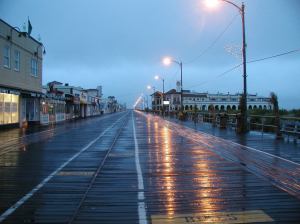
Ocean City, Maryland, and its boardwalk puts on a grand show for tourists. On the stage they find clean entertainment: smart aleck tee shirts, picture key chains, incense, hermit crabs, caramel popcorn, salt water taffy—everything costs a mint, payment in cash.
Behind that façade, where smorgasbord eaters can’t see, live the stiffs who work at crab shacks or wrap threadlocks in your kids’ hair. Girls from Europe and former soviet countries; boys on work permits from England, Scotland or Ireland. They slum in efficiency apartments by the half dozen drinking Rolling Rock beer. They smoke pot on balconies, blaring Alice in Chains three blocks from the minivans in the inlet.
That’s how Nols met Penny: they both waited tables at a seafood restaurant on the bay. Moises cooked in the kitchen. All day the fishing boats and jet skis motored across the water, cutting wake. Nobody called him Allen that summer—plain, boring Allen. Penny, who came from London, started calling him Nols because his last name is Nolan. Everyone else did, too.
On slow days, the waitstaff pretended they came from different countries. Nols faked being from Dublin but sounded Scottish; Penny played American. “Welcome! I’m Lisa, a college student from Indiana,” Penny told a table of four guys on a golf vacation. “Customers tip better when they think you’re poor, young and American,” she told him later and put her finger to her lips in a silent Shh.
Nols was a local, living with his parents before going back to Frostburg State in the fall: he knew she was right.
*
In his wallet, Nols kept his two favorite pictures of Penny, half a column of those four black-and-white shots that only come from photo booths. The kind that go in sequence. The kind that couples buy on the boardwalk to mark their romance’s giddy beginning.
That July evening Nols had spun the stool to the right height, crammed in the tiny booth with Penny on his lap, then pulled the powder blue curtain closed. The light was hot, like he imagined a movie set would be, and there they were together: his hands pressed against her ribs, feeling her breath; Penny grinning, her crooked eyeteeth turned out. Then the camera flash, sharp, unexpected.
They held the photographs, still wet with chemicals, and agreed Penny would keep the first two snapshots, and Nols the others. He had memorized the entire progression. In the first two, Penny and he were smiling, her temple on his cheek; the third, they wagged their tongues. The fourth picture captured them kissing, like kids’ faces pressed on a window, their teeth clicking against each other. Nols and Penny laughed afterward, surprised and embarrassed by what just happened: their first kiss.
As a border guard on the east side of the Wall you had only heard the word as a faint echo,
(Photo from the German Missions to the United States, Germany Info )
somewhere beyond. But it grew louder at midnight as people gathered at the gate, their traveling papers in hand. Thousands stood shoulder to shoulder.
Other guards looked to you then lowered their rifles as Berliners, east and west, fell into one another, embracing, laughing through sobs.
An old man wept, pausing at the checkpoint, rebalancing on his cane, before walking to meet his family again. Twenty years. He had bought and kept all of their birthday gifts for two decades, waiting. Boys with hammers and axes climbed the wall. They scanned, turning, taking in the whole of Berlin, and smiled, shouting, then striking the wall. They chipped the concrete until it finally cracked.
You nodded then reached in your parka for a cigarette. A united Berlin; this was truly a night to celebrate.
Classic German Army Cold Weather Parka. Four front pockets and one inside meant you never ran out of space for gear. Heavy duty material with hood and removable fleece liner promised years of all-season wear.
Zipper and button fastening. Shoulders finished with tri-color, stitched German flag. Drawstrings at waist and hood. Durable. Comfortable.The start of a revolution.
After seeing Jim Carrey’s video love note to Emma Stone, either he’s channeling Charlie Sheen or he’s really, and I mean, really bad at asking a girl out.
Writers: Jim Carrey shows you how not to get published. (From TruLife)
It’s an eerie combination of overly earnest, creepy, and only vaguely funny. Sure, what 22-year-old woman doesn’t want to hear a guy who’s nearly 50 talk about their future of chubby, freckle-faced babies and how the ravages of time affect his bodily functions?
The answer: all of them.
Many younger writers, so full of the need to express themselves (they’re so deep!), pull a Jim Carrey. They pour out every emotion, every bit of angst. They’re frustrated and railing against something. They’re begging and screaming for attention, not caring that it’s attention for all the wrong reasons. It’s like Jerry MacGuire: “Sooth me. Save me! Love me!”
Editors and readers will be more than happy to ignore this self-centered, whining story. And if that doesn’t drive the message home then the stack of rejection letters will. Because what Jim Carrey dashed off was a terrible, clumsy attempt at courting — the equivalent to a horrible first draft.
Hey, we’ve all been there. I’ve deleted or tossed hundreds of stories. Thousands of pages. It’s the fawnlike steps toward becoming a confidant writer, one who can write about what he or she cares about while making it interesting to an audience. Simply put: Forget your ego. Realize you that it’s about them — their wants and needs.
But write your heart out. That’s what first drafts are for. Just make sure that you revise and edit until the story has that same effect on your audience, not just you.
If that seems like an alien concept, then watch this video and pretend you’re Emma Stone. That’s probably how your readers feel — they’re just too nice to tell you.





 Shawn Proctor