Shawn Proctor is a fiction writer living in the greater Philadelphia area. He graduated from the MFA Program at Rosemont College and the Professional Writing Program at Kutztown University.
His fiction has appeared or is forthcoming in the Our Haunted World Anthology, Schuylkill Valley Journal, Storyglossia, Mississippi Crow, The Circle, The StoryTeller, and BlazeInk, and was a finalist in The Delaware Beach Life Writing Contest.
He is currently working on his first novel.
His journalism has appeared in The Philadelphia Inquirer, Main Line Today, Ale Street News, and Victory Brewing Company's Web site, and he published a roleplaying module with Chaosium, Inc.
I don’t know how you have been getting along all of this time without an elder god munching on your feet, but it’s time to stop. Thanks to ThinkGeek, you can slip into something a little more sinister with these Cthulhu Slippers. It’s the perfect thing for when you’re scribbling your latest spells in that skin-bound tome you found in Walter Corbitt’s basement.
Psst…kids. H.P. Lovecraft’s books are all available on the interwebs. Set course for insanity, evil impulse speed!
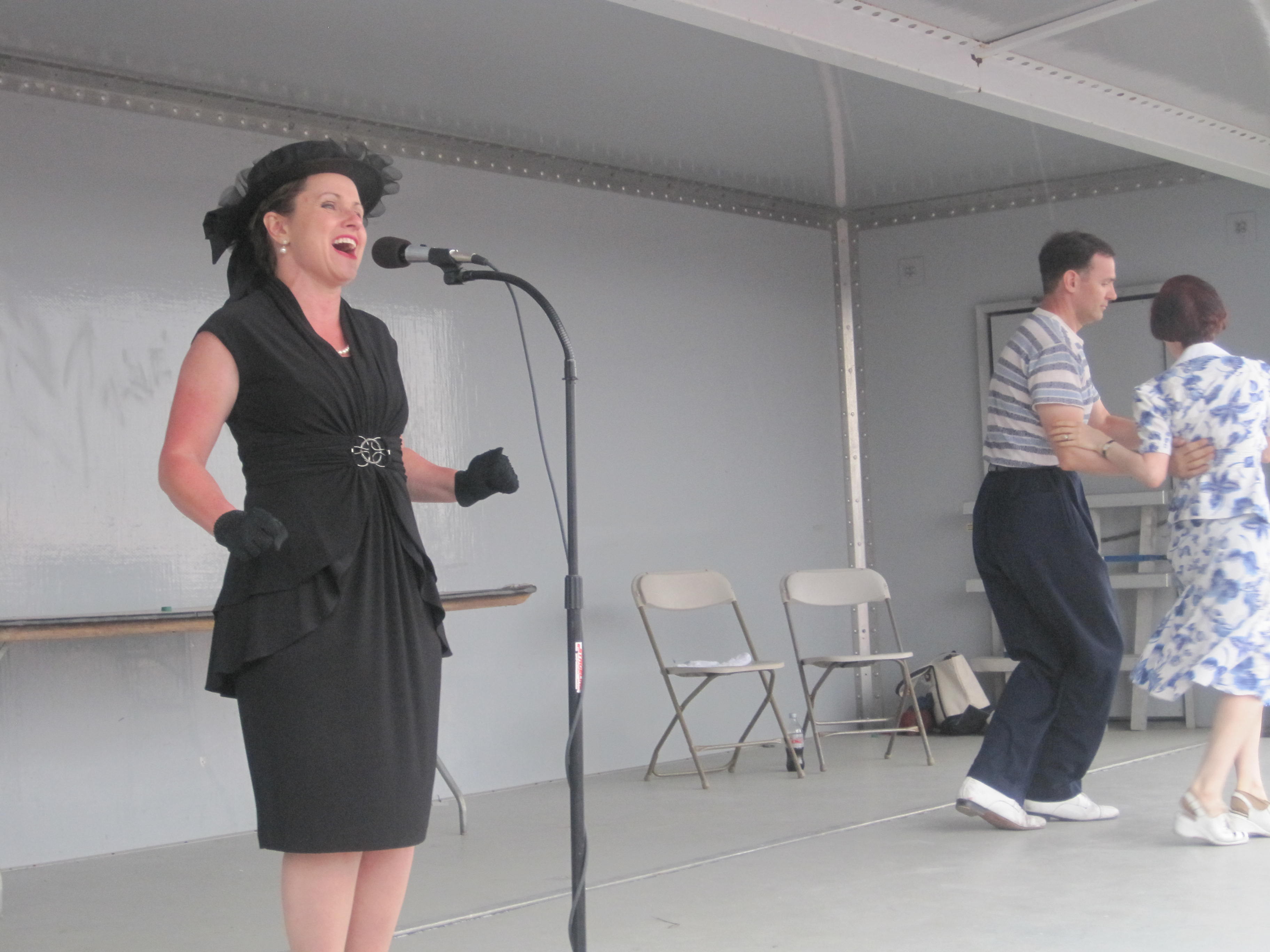
In retrospect, Theresa Eaman, an area jazz singer, was the real surprise of the musical acts booked Saturday. She is one of those voices who breathes life into the torch songs from the era.
It was so authentic, if I closed my eyes I practically could hear the hiss of the record and smell the stale smoke in the club.
In case you missed Dar Williams’ concert in King of Prussia over the weekend, check out my review at CultureMob Philly.
A few years ago, I’d noticed that midway through a typical Dar show that women would begin dancing in a large group off to the side. Well, maybe someone hit a reset button on the audience age, because the dance party–right in front of the stage now–is skewing young, really young:
“And though they may be tiny—just two to five years old—their passion is mighty.”
The girls were pretty awesome, there’s no doubt. And I, for one, welcome our new diminutive overlords.
Authors and would-be authors know ebook Piracy is on the rise. Just like digitizing songs (read: Napster) put every piece of music ever at your fingertips (legally or otherwise), ebooks and online magazines places nearly any book or article within easy download and create similar opportunities for illegal downloads. Throw in movies and television, and there’s practically no way to keep up with new, worthwhile content.
Image: Media Bistro
Back to ebooks though. If you are like me and believe authors deserve to be appropriately compensated for their electronic novels, what should you do? Vanessa K. Wright offers an interesting payment scheme in her blog, which would set two prices, based on whether you want your book sans advertising:
“Option 1 (U.S. TV model): The ebook is free to the consumer, but you have ads every X amount of chapter breaks. Option 2 (U.K. TV model): The consumer pays for the book, but there are no ads.”
Or a service like Netflix could step in to offer monthly access to print books and limited time downloads for a limited selection. If anything, this would likely worsen the crisis facing bookstores. Remember Blockbuster or the movie rental store? Well, it’s likely your kids won’t remember them or the big box book stores either.
If publishers are making an inferior product and the illegal one is substantially better, Wil Wheaton argues the industry is practically herding readers to download illegally. He explains that DRMs suck and contribute to ebook piracy, but scrupulous readers could choose to download the book illegally then make a contribution directly to the author. This is a variation on the pay-what-you-will scheme that some indie musicians have tried.
Which payment model, if any, would you prefer?
Here’s some real food for thought: ebook piracy can be a good thing. Yes, good. Good for artists, good for readers, good for the industry. (Not that stealing or plagiarizing is OK. That’s for a different day though.) I argue all piracy, in one form or another, is opportunity in disguise.
The Grateful Dead encouraged fans to record live concerts, which in turn created even more demand for their shows. OK Go works with its audience to create unbelievable videos fans can’t help but share, driving interest in the band and in their concerts. It can work for books, too.
Welcome to the new meritocracy, where the public becomes the taste makers and the balance of power shifts away from the traditional industry gatekeepers.
Scott Turow, best selling author and president of The Author’s Guild, takes the sky is falling stance. Copyright is coming undone; people are sharing and profiting without author consent. So does Youtube when it runs ads before videos hosted on the site. And same goes for libraries charging for overdue library books. And Amazon when it places an ad for Weight Watchers on Tim O’Brien’s listing for The Things They Carried.
How does a fractured marketplace and digital piracy create opportunity? Even writers who have a huge audience can boost their overall sales by putting out material for free. And piracy becomes like when readers lend great books to one another or borrow them from the library. Sharing creates interest in the author and his or her future works. A satisfied reader, I believe, will buy the next book then share it other friends and family, who then may buy older books. Nurture that audience and legit books sales will spike. Or, as one famous, successful, and clever author noted:
“In a widely circulated video produced with the Open Rights Group, author Neil Gaiman recounts how the correlation of sharing and sales led him to experiment with making his work available for free. ‘…I started to notice that in places I was being pirated—particularly Russia—I was selling more books. And I started to realize that actually you’re not losing sales by having stuff out there. You know, that’s really all this is: It’s people lending books.'”
The galleons are in the water and have been for a long time. Digital piracy, no doubt, will only grow in coming years. So stop fighting the pirates. For emerging authors, this might be just the perfect wind needed to launch their careers.
Too busy to post a full update. I’m working on a blog about ebook piracy and writing away at my work-in-progress. I’m spending a lot more time on Twitter than Facebook in recent weeks. Hope to see you there.
“The aim of the artist is to arrest motion, which is life. A hundred years later, a stranger looks at it, and it moves again.”
– William Faulkner
“I write because I don’t know what I think until I read what I say.”
– Flannery O’Connor
“Writing is a duty for me as a survivor.”
– Elie Wiesel
“I find that process has started to become essential to me in my life, just as it is to take walks, to exercise, to eat, to rise a bicycle. It’s part of maintaining myself in the world,
of keeping myself healthy.”
– David Leavitt
My grandfather passed away Sunday at the age of 89. I was asked to write up a remembrance of him, based on the writings he left behind.
My grandfather on his wedding day.
World War II veteran took a lucky leap of faith
A series of fortunate events gave Merle Elmer Brann the opportunity to meet the love of his life. And unlike Rhett Butler, the dashing rogue from his favorite film Gone With the Wind, he didn’t allow his Scarlett to slip away.
When he enlisted in the U.S. Army in 1940, a year after graduating from high school, a chance conversation with a friend in a hallway delayed him from signing up the day he had intended. It also kept him from a tour of duty in the Philippines, from where very few returned.
Mr. Brann finished basic training at Camp Jackson, S.C. (later renamed Fort Jackson), and, as a member of the 20th Regiment of the 6th Infantry Division, he participated in the largest peacetime maneuvers in Army history.
Stationed on Kodiak Island, Alaska, he was involved in an automobile accident while on guard duty. His head and shoulder injuries were so severe the doctor assumed he would die and didn’t clean the wound. Yet fortune smiled yet again—although he remained in the hospital for ten weeks, Mr. Brann fully recovered. Years later, gravel pieces from the road would still appear on his scalp, a reminder of that fateful night.
He declined a medical discharge, based on the accident, out of feelings of duty and loyalty. He didn’t want to leave his men.
Promoted to Staff Sergeant, he was sent to school to receive training in Army Engineering Training School as a camouflage instructor. June, 7, 1945, he met Josephine Agnes Sutton in a Washington, D.C., nightclub and, luckily, they happened to share a bus headed the same direction. They struck up a conversation, and he offered to visit her hometown the next day.
Both knew there was something special—maybe even love at first sight—but time was short. His school was ending in less than two weeks. Afterward, he expected to be sent to California, clear on the other side of the country. So he mustered up his courage and proposed marriage on Wednesday, June 12.
“It was the only way we could be together,” she recalls. “So I said ‘yes.’”
One day after school ended—just three weeks after meeting—they wed on June 23 at Saint Paul’s Episcopal Church in Alexandria, Va. Pressed into quick service, most of his groomsmen were fellow members of the Army. Most of Josephine’s family attended, though travel during the war was difficult.
Maybe he wasn’t exactly Rhett Butler. Maybe she wasn’t Scarlett. But, in the end, together they embarked on the greatest of adventures: 65 years of wedded bliss.
In his later years, he struggled with lymphoma and lung cancer. Through it all, he always kept his good humor and sunny disposition, his faith and family ties. He passed away on March 27, 2011, at the age of 89, surrounded by his children and—of course—Josephine.
It was the right ending for a romance too good for the silver screen.
After three weeks of trying out Michael Chabon’s Sunday-Thursday writing plan (see “Personal Life” for 1,000 words/day, five days a week schedule), I quickly (at least compared to my normal routine) generated 15,000 words. Scenes upon scenes became chapters upon chapters.
Then the bad news: I ran out of road on my fragmented, sparse outline.
This is the third time working on this particular novel in five years. Like a hiker walking through the woods by flashlight, I knew where I was, but only vaguely where I had been.
Then a writer friend recommended the Shrunken Manuscript Technique (SMT). It sounded like a great way to get an overview of the completed manuscript’s scenes, effective chapters, and themes. Here’s the gist of what I learned.
1. Just because it’s interesting doesn’t mean it’s part of the story. First and second draft, I tried different voices, tenses, points-of-view. So, too, every theme and event I thought could work in the novel. Lost in all of that was an interesting, compelling story that I could parse out thanks to a global view of the work.
2. Outlines create the skeleton, drafts create the heart. I treated outlining like doing taxes, as if planning would drain the soul from the novel. It ended up mush, so stuffed new plot threads it couldn’t settle down and tell one story.
Reverse engineering an outline from my draft, I see that the early chapters push the readers along and a lot happens, but nothing pays off. This is an easier fix than it sounds like when you remember …
3. Everything needs to connect back to the character. Know what he or she wants, create an antagonist and obstacles, and then make things as hard as possible. Heap on bad, then do it some more. The stuff outside of that should develop the character or world, at minimum. Can’t explain exactly why the character is in a scene and it doesn’t add to the plot, world, or characters? Then it’s just stuff. Stuff that can be cut.
4. Just because you’re not writing, doesn’t mean you’re not creatively engaged. At some point, maybe a year ago, I should have said to myself, “Stop writing for a minute. Figure out what you’re writing about.”
I had learned that writing was about the number of words you kept putting on the page. So I kept pushing the draft along, slowly learning about the setting and characters, but not what story would matter to them. With SMT, I couldn’t read the whole novel and lose the forest for the trees. (I’d go blind trying.) Forced to truly consider the basic arc of events I realized even the best scenes only work when they make the reader ask “What happens next?”
I know the characters and have written up a rough time line and outline. In the end, I’ll probably cut about a quarter of this draft to get down to what really matters.
I’m working on an outline for my novel, which is now easily a full length manuscript. At times I had a comprehensive outline then went off of it to follow a plot thread that seemed interesting. When I was working on a draft the urge to keep moving ahead meant any relevant outline only contained the plot threads and overall story arc.
Five years, three drafts, and 110,ooo words. It started in first-person, present tense then shifted to third-person, past tense. So many trees, so much forest.
In an effort to see the whole manuscript at once, consider the whole story arc, and create an accurate and useful outline and character descriptions, I’m trying out the Shrunken Manuscript Technique. Look for an update about the experience next week. (Crosses fingers.)
Contest: Want to win a free book? Then tell me about your struggles, triumphs and strategies right here, and at the end of the month you may be randomly selected to win a book, featuring one of my short stories. More details to come!




 Shawn Proctor